
Enzymes and Inhibitors



Bioworld Lysozyme, 25 g
Lysozyme Enzyme used in purification protocols of genomic and plasmid DNA to lyse bacterial cells.Ultra Pure GradeSource: Hen Egg White (also called Hen Egg Lysozyme or HEL.)Activity(25 C): >20,000U/mgAlbumin: None detectedSalmonella: None detected

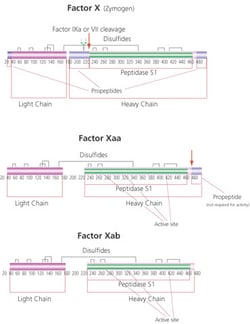
Sigma Aldrich Fine Chemicals Biosciences Factor X Activated (Xa) from Bovine Plasma | 9002-05-5 | MFCD00163610 | 50ug
Factor X Activated (Xa) from Bovine Plasma | 9002-05-5 | MFCD00163610 | 50ug


FUJIFILM Biosciences Cholesterol Esterase | 9026-00-0 | MFCD00071052 | 1000u
Cholesterol Esterase | 9026-00-0 | MFCD00071052 | 1000u

Sigma Aldrich Fine Chemicals Biosciences beta-Glucuronidase from Escherichia coli Type VII-A, lyophilized powder, 5,000,000-20,000,000 units/g protein, pH 6.8 (30 min assay) | 9001-45-0 | MFCD00130629 | 5KU
beta-Glucuronidase from Escherichia coli Type VII-A, lyophilized powder, 5,000,000-20,000,000 units/g protein, pH 6.8 (30 min assay) | 9001-45-0 | MFCD00130629 | 5KU

Sigma Aldrich Fine Chemicals Biosciences N-Hippuryl-His-Leu hydrate powder, >=98% (HPLC) | 207386-83-2 | MFCD00149318 | 1G
N-Hippuryl-His-Leu hydrate powder, >=98% (HPLC) | Purity: >=98% (HPLC) | 207386-83-2 | MFCD00149318 | 1G

Sigma Aldrich Fine Chemicals Biosciences Superoxide Dismutase from bovine erythrocytes BioReagent, >=3,000 units/mg protein, suitable for cell culture, lyophilized powder | 9054-89-1 | MFCD00132404 | 15KU
Superoxide Dismutase from bovine erythrocytes BioReagent, >=3,000 units/mg protein, suitable for cell culture, lyophilized powder | 9054-89-1 | MFCD00132404 | 15KU

Sigma Aldrich Fine Chemicals Biosciences Neuraminidase from Clostridium perfringens (C. welchii) Suitable for manufacturing of diagnostic kits and reagents, Type V, lyophilized powder | 9001-67-6 | MFCD00131711 | 250UN
Neuraminidase from Clostridium perfringens (C. welchii) Suitable for manufacturing of diagnostic kits and reagents, Type V, lyophilized powder | 9001-67-6 | MFCD00131711 | 250UN
Sigma Aldrich Fine Chemicals Biosciences Cellulase from Trichoderma reesei aqueous solution, ≥700 units/g | 9012-54-8 | MFCD00081510 | 50mg
Cellulase from Trichoderma reesei aqueous solution, ≥700 units/g | 9012-54-8 | MFCD00081510 | 50mg
Sigma Aldrich Fine Chemicals Biosciences Glucose-6-phosphate Dehydrogenase from baker's yeast (S. cerevisiae) | 9001-40-5 | MFCD00081656 | 500 units
Glucose-6-phosphate Dehydrogenase from baker's yeast (S. cerevisiae) | 9001-40-5 | MFCD00081656 | 500 units
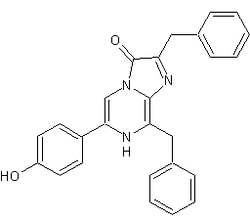
Prolume Ltd Coelenterazine h | 50909-86-9 | MFCD00798394 | 10 mg
Coelenterazine h | Mol Wt: 407.5 | 50909-86-9 | MFCD00798394 | 10 mg

Sigma Aldrich Fine Chemicals Biosciences Diaphorase from Clostridium kluyveri lyophilized powder, 3.0-20.0 units/mg protein (biuret) | 9001-18-7 | MFCD00130947 | 100un
Diaphorase from Clostridium kluyveri lyophilized powder, 3.0-20.0 units/mg protein (biuret)Purity: MW: | 9001-18-7 | MFCD00130947 | 100un

Sigma Aldrich Fine Chemicals Biosciences Phosphatase, Alkaline from bovine intestinal mucosa >=2,000 DEA units/mg protein | 9001-78-9 | MFCD00131849 | 10KU
Phosphatase, Alkaline from bovine intestinal mucosa >=2,000 DEA units/mg protein | 9001-78-9 | MFCD00131849 | 10KU

Sigma Aldrich Fine Chemicals Biosciences Glucose-6-phosphate Dehydrogenase from Leuconostoc mesenteroides Type XXIII, ammonium sulfate suspension, 550-1,100 units/mg protein (biuret), >=2.0 mg/mL Biuret | 9001-40-5 | MFCD00081656 | 200UN
Glucose-6-phosphate Dehydrogenase from Leuconostoc mesenteroides Type XXIII, ammonium sulfate suspension, 550-1,100 units/mg protein (biuret), >=2.0 mg/mL Biuret | 9001-40-5 | MFCD00081656 | 200UN

Sigma Aldrich Fine Chemicals Biosciences Peroxidase from horseradish Type I, essentially salt-free, lyophilized powder, >=50 units/mg solid (using pyrogallol) | 9003-99-0 | MFCD00071339 | 50KU
Peroxidase from horseradish Type I, essentially salt-free, lyophilized powder, >=50 units/mg solid (using pyrogallol) | 9003-99-0 | MFCD00071339 | 50KU
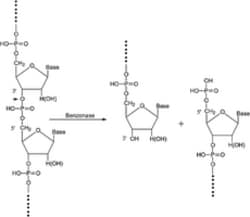
Sigma Aldrich Fine Chemicals Biosciences Benzonase Nuclease, 9025-65-4, MFCD00131010, 25 KU
≥250 units/μL, ≥90% (SDS-PAGE), recombinant, expressed in E. coli, buffered aqueous glycerol solution, storage temp: −20°C, Synonym: Endonuclease from Serratia marcescens.